
Choose the right glass for the right performance
For architects, facade engineers & project managers in the Dubai / GCC market | May 2026
You’ve seen it happen. A spec says “6mm clear glass,” and nobody questions it until the energy model comes back, the solar gain numbers are catastrophic, and the project is already halfway through tender. Or a panel gets installed in a balustrade location that needed laminated glass, and the consultant flags it on day one of the WIR.
Glass is the biggest single performance element in most modern facades. It controls thermal loads, acoustics, structural resistance, and post-breakage safety all at once. In Dubai’s climate, where surface temperatures hit 70-80 degrees C and the sun is relentless year-round, the gap between the right glass and the wrong glass isn’t subtle. It’s the difference between a building that passes regulatory review and one that doesn’t.
This guide covers every major glass type used in facade work: what it is, what it’s built for, and when you have no choice but to use it. Architect selecting glass for a curtain wall, facade engineer preparing a technical submittal, project manager trying to understand why the consultant keeps rejecting the proposed IGU configuration – this should answer it.
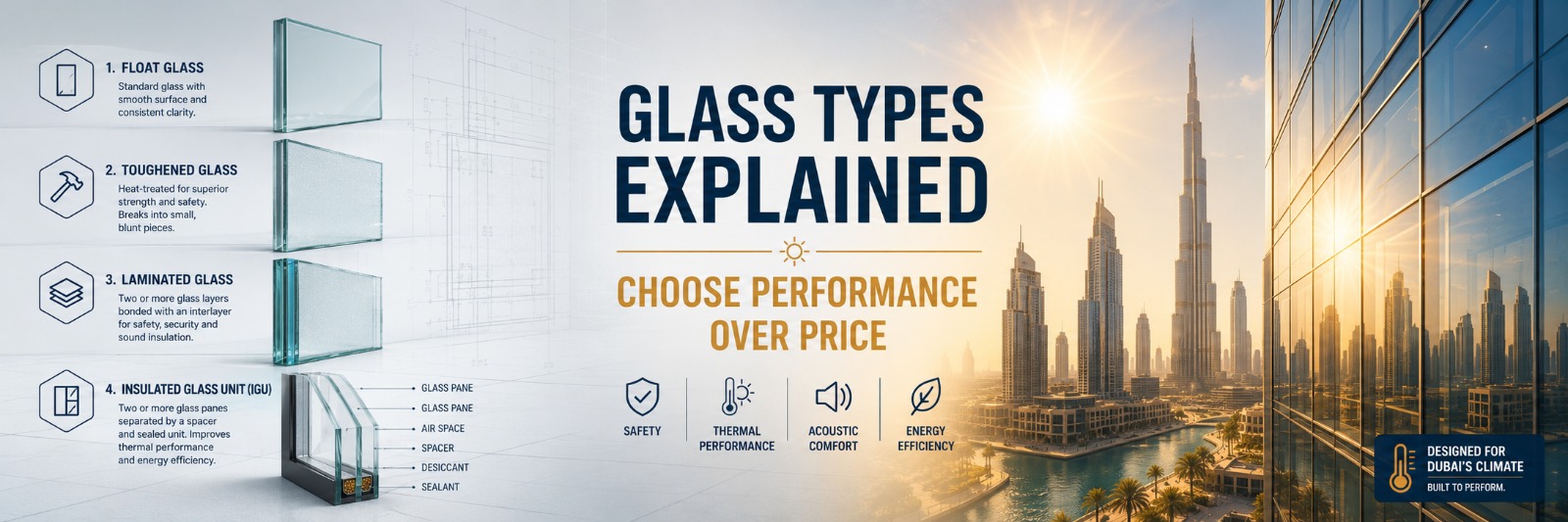
Quick Comparison: Glass Types at a Glance
| Glass Type | Best for |
| Float glass | Economical and clear – best for basic interiors and internal partitions |
| Toughened glass | Stronger and safer – ideal for facades, doors, and railings |
| Laminated glass | High safety and sound control – suitable for skylights, balustrades, and public areas |
| IGU / Double glazing | Better thermal and acoustic insulation for high-performance facades |
| Low-E glass | Improves energy efficiency by reducing heat transfer – essential for Dubai climate compliance |
| Reflective / tinted glass | Controls glare and solar heat while improving the exterior look of the building |
| Frosted / etched glass | Adds privacy while maintaining light transmission |
| Wired glass | Used where fire-rated integrity performance is required – confirm Civil Defense acceptance |
Why glass type selection is a technical decision, not a commercial one
Cost is usually the first conversation. It shouldn’t be. Glass selection driven primarily by price tends to end in one of three places: a regulatory rejection from Dubai Municipality or Civil Defense, a thermal or acoustic shortfall during commissioning, or a safety NCR that requires expensive rectification after installation.
Glass type governs structural capacity, thermal performance, acoustic insulation, post-breakage safety, fire performance, and compliance with Dubai Municipality’s Green Building Regulations. All of those things, simultaneously, from a single material choice.
Get it right in the specification, and everything downstream is clean. Get it wrong, and you’re still dealing with NCRs after the scaffolding has come down.
The performance numbers that matter
There are five metrics your consultants and authorities will check. Worth understanding what they mean before you’re sitting across from a thermal engineer.
| Metric | What it measures | Dubai / GCC target |
| U-value (W/m2K) | Rate of heat transfer through glass. Lower = better. | <=2.0 W/m2K (Dubai Municipality typical maximum) |
| SHGC | Fraction of solar energy entering the building as heat. | <=0.25 (Dubai Municipality typical) – the critical metric for hot climates |
| VLT (%) | Visible light transmitted through glass. | Balance high daylight (60%+) with low SHGC – selectivity index VLT/SHGC >= 1.5 |
| Rw (dB) | Sound reduction index – acoustic insulation performance. | Standard office: Rw 35-40. Hotel/residential bedrooms: Rw 40-45 |
| Thickness (mm) | Structural capacity – must be verified by wind load calculation. | Per EN 13474 or ASTM E1300 – never assumed |
The core glass types
1. Annealed (float) glass
Float glass is the base material everything else starts from. Molten glass floats on a tin bath, cools into a flat uniform sheet, and leaves the factory with no heat treatment, no coating, no lamination.
It’s weak. It breaks at relatively low stress levels, and when it breaks, it breaks into large sharp shards. In modern facade work you’ll almost never see raw annealed glass used alone – it shows up as the raw input that goes into the strengthening furnace, or as a lite in a laminated unit where the interlayer makes it safe. In fabrication datasheets, “annealed” just means unprocessed.
Very low-stress internal partitions are the exception where it might appear. Anywhere with safety exposure, use processed glass.
2. Heat strengthened (HS) glass
Heat strengthened glass starts as float, gets reheated to around 620-650 degrees C, then cooled with controlled airflow. That thermal cycle creates surface compressive stresses of 24-52 MPa – roughly twice the strength of annealed.
It’s the workhorse of commercial facade glazing. Most curtain wall vision panels, spandrel glass, and general glazed elements in Dubai commercial projects are heat strengthened. The breakage pattern matters too: HS glass fails in large pieces rather than particles, which is actually useful on the outboard lite of an IGU – the broken pane tends to stay in the frame.
Key note: HS glass cannot be cut or drilled after processing. All edge work, holes, and notches go in before the glass goes into the furnace. Confirm this sequence with your supplier at submittal stage.
3. Tempered (toughened) glass
Tempered goes through the same process as heat strengthened, faster and more intense. Surface compressive stresses reach 69+ MPa – about four times stronger than annealed.
The practical difference is the breakage pattern. Tempered doesn’t shatter into large shards. It breaks into thousands of small blunt fragments (“dice”), which is what earns it the safety glass classification and makes it mandatory in certain locations.
Mandatory locations (confirm per spec and local code): balustrades and guardrails, door leaves, sidelights adjacent to doors, low-level glazing below 800mm from floor level, wet areas, and any glazing where human impact is foreseeable.
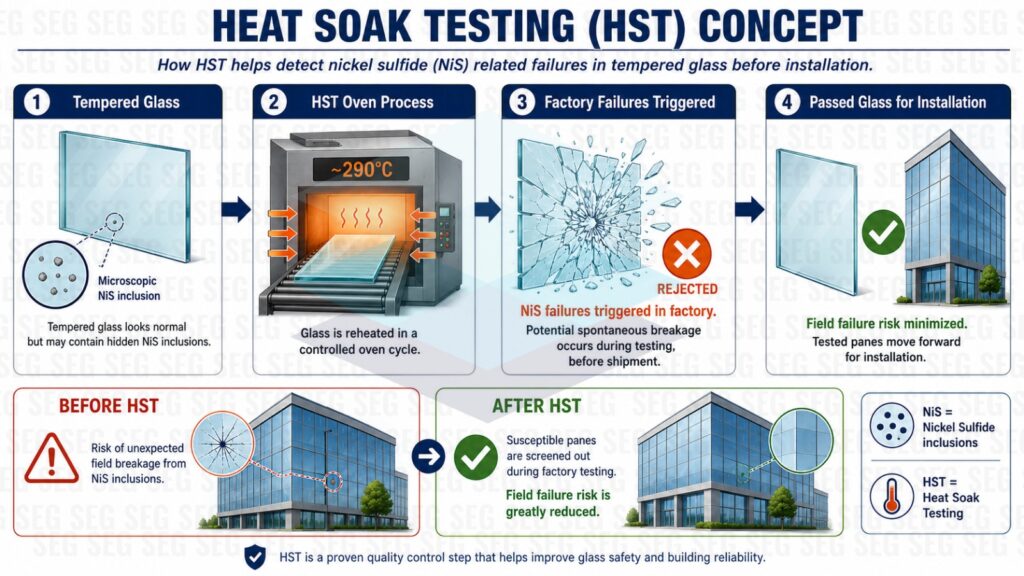
Spontaneous breakage risk: Tempered glass can fail without being touched, triggered by nickel sulfide (NiS) inclusions that expand slowly over time. For overhead glazing and structural applications, specify Heat Soak Testing (HST) per EN 14179 – it flushes out latent NiS failures in the factory rather than on the building.
| Factor | Heat strengthened | Tempered |
| Strength | ~2x annealed | ~4x annealed |
| Breakage | Large shards | Small dice |
| NiS breakage risk | Low | Higher – consider HST |
| Post-breakage retention | Good | Poor (dice fall out) |
| Safety glazing classification | No | Yes |
For most curtain wall vision areas in Dubai, heat strengthened is correct. Tempered is specified where the safety glazing classification is mandatory, or where structural loading demands it.
4. Laminated glass
Laminated glass bonds two or more lites together with a plastic interlayer under heat and pressure. When the glass breaks, the interlayer holds the fragments in place. The panel stays as a barrier.
That’s why laminated glass is mandatory in any overhead application. Skylights, atria, canopies – if someone could be below a failing pane, the inboard lite must be laminated at minimum. Civil Defense won’t accept anything less.
Other mandatory situations: balustrades and structural glass floors, acoustic specifications at Rw 40+ dB, blast and hurricane applications, and point-fixed spider glazing where stress concentration at each fixing makes post-breakage behaviour critical.
The interlayer choice matters:
- PVB: The standard. Cost-effective, good clarity, appropriate for most balustrade, overhead, and acoustic applications.
- SGP (ionoplast): About 100 times stiffer than PVB at elevated temperatures. Required when the laminate must remain structurally functional after one lite breaks. More moisture-resistant than PVB at exposed edges.
- Acoustic PVB: Formulated to damp sound vibrations. Pair with asymmetric glass thickness (6mm outer, 10mm inner) to target different resonant frequencies. This combination is what gets projects past Rw 40 dB.
- EVA: Handles wet areas and UV stability requirements. Less common in standard facade work.
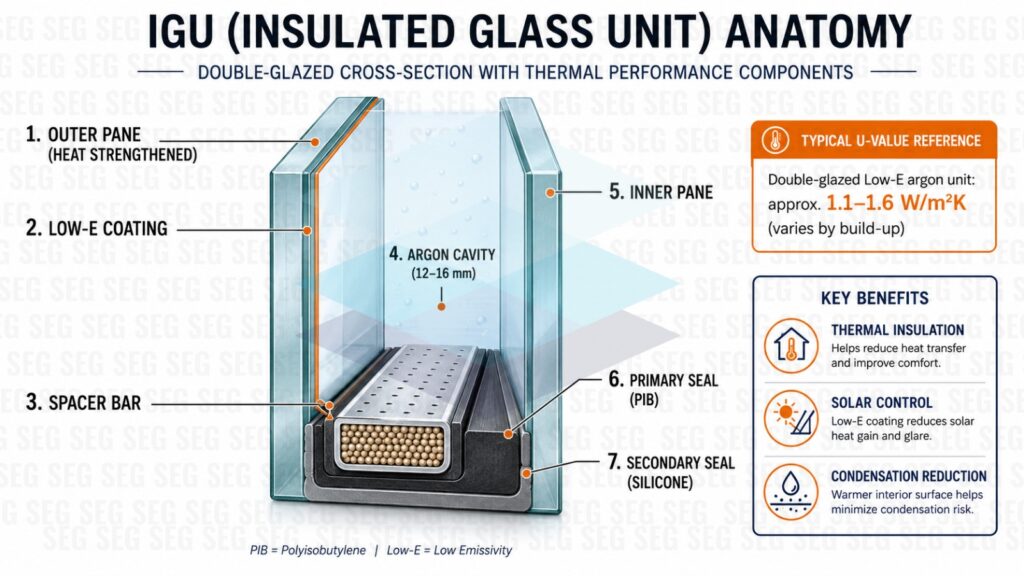
5. Insulated glass units (IGUs)
An IGU is two or more lites separated by a spacer and sealed to trap a gas cavity. The cavity is the insulation. Without it, glass has essentially no thermal resistance – a 6mm panel has a U-value of around 5.8 W/m2K, well above what Dubai Municipality permits.
Standard Dubai commercial specification: 6mm or 8mm heat strengthened outboard lite with solar control Low-E coating on Position 2 (inner face of the outer pane), 12-16mm argon cavity, 6mm heat strengthened or tempered inboard lite, dual-seal edge (PIB primary for moisture resistance, silicone or polysulfide secondary for the structural bond). Target U-value <=1.8 W/m2K. Target SHGC <=0.25.
Two details that get missed: use warm-edge spacer bars if targeting U-values below 1.8 – standard aluminium spacers create a thermal bridge at the edge. Triple-glazed units exist for projects below 1.0 W/m2K or chasing serious acoustic performance, but weight and frame depth implications need to be cleared with the structural engineer before the spec is locked.
On site: the edge seal is the most failure-prone component. Any unit that arrives fogged between the panes has a failed seal – reject it on the MIR, segregate it, don’t install it.
6. Low-E and solar control coatings
Low-E coatings are thin metallic or metal-oxide layers on the glass that selectively manage solar transmission. In Dubai’s climate, the job is reflecting near-infrared radiation (heat) back outside while letting visible light through. Good selectivity means bright interiors without the heat load.
Position matters. For solar control in hot climates, the coating sits on Position 2 – the inner face of the outer pane, facing the cavity – so incoming solar energy gets reflected back out before it warms the air inside the unit.
Hard coat (pyrolytic): Applied during float glass manufacture. Durable, can be single-glazed, but lower solar control performance. Soft coat (sputtered): Applied in vacuum deposition after manufacture. Better SHGC and selectivity. Standard for Dubai commercial work – but must be sealed inside an IGU, can’t be left exposed.
The selectivity index (VLT divided by SHGC) tells you how efficiently the coating separates daylight from heat. For Dubai, target >=1.5. Premium coatings hit 1.7-2.0+. High external reflectivity has planning implications – check whether the authority restricts reflectivity, and whether the coating could cause glare problems for neighbouring buildings.
7. Fire-rated glazing
Fire-rated glazing is a different product category, not an upgraded standard glass. You can’t specify a “better” IGU and achieve a fire rating. The physics are different.
- E (Integrity only): Holds back flames and hot gases for the rated period – E30 or E60. Doesn’t stop radiant heat. Right for fire doors, corridor screens, and locations where the unexposed side doesn’t need to stay cool.
- EI (Integrity and Insulation): Holds back flames and gases, and limits temperature rise on the unexposed face. Required where people shelter behind the glass, in firefighting lobbies, or anywhere the specification demands full compartmentation. An EI60 unit can reach 50-80 kg/m2 or more. Check frame and structure loading early.
What catches projects out: the glass alone doesn’t have a fire rating. The rating belongs to the tested assembly – glass, frame, fixings, intumescent seals, everything together. Fire-rated glass in a standard curtain wall frame has no fire resistance. Civil Defense requires the complete system test certificate. Factor their review time into the programme.
8. Structural glazing
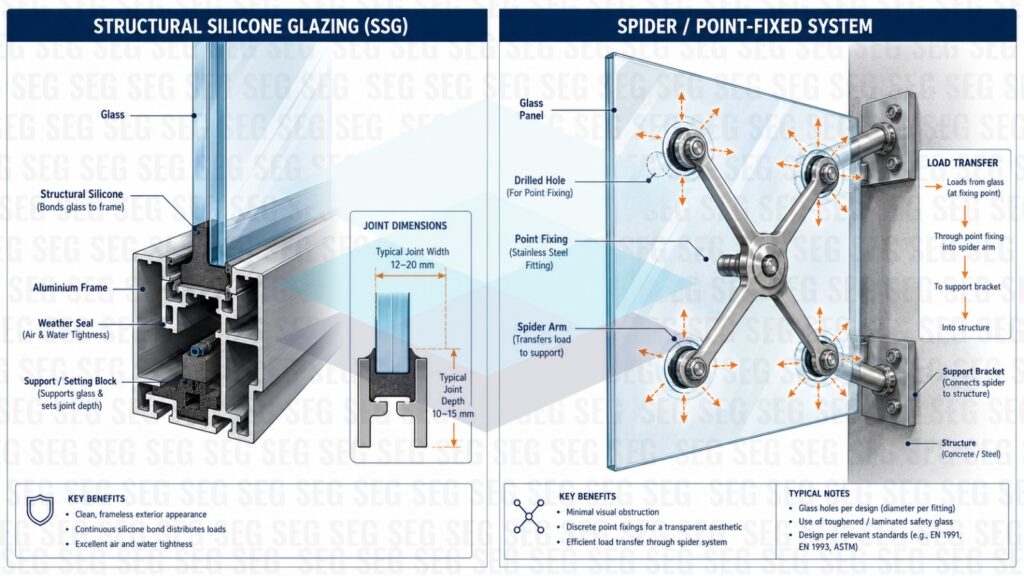
In structural glazing – silicone-bonded (SSG) or point-fixed (spider) – the glass carries loads that framed glazing doesn’t see.
- SSG: The glass is bonded to the aluminium frame with two-part structural silicone, which carries the dead weight and out-of-plane wind loads. Joint dimensions (DC width and depth) come from a calculation to ETAG 002 or the manufacturer’s design guide – not estimated. Laminated glass with heat strengthened lites is the right configuration. Tempered should generally be avoided as the sole lite: if it shatters into dice, the bond line loses its backing. Glass edges must be polished smooth.
- Spider glazing: Panels supported at discrete fixings through drilled holes – high local stress concentrations. Laminated glass with SGP interlayer is standard. Heat strengthened (not tempered) is preferred at the holes; the stress concentration there makes NiS failures a real risk. Supporting structure deflection limits need to come from the structural engineer before fixing geometry is finalised. Spider systems are sensitive to inter-storey drift.
Specifying glass for Dubai and the GCC
Solar control is the first constraint, not an afterthought. SHGC <=0.25 is the typical Dubai Municipality requirement, and a high-selectivity soft-coat Low-E IGU with an argon cavity is how you get there. Single-glazed or uncoated solutions won’t pass the thermal analysis.
Thermal expansion isn’t always on the spec sheet, but it shows up in the field. Aluminium moves at 23 x 10-6/degrees C. A 70-degree surface temperature swing – common between a Dubai winter night and peak summer – produces 1.6mm of movement per metre. That has to go somewhere. Check edge clearance and frame bite at detail design stage before the drawings are issued.
Wind loads on UAE high-rise, particularly on coastal and waterfront sites, are not trivial. Glass thickness is a structural calculation, not a table lookup. Use EN 13474 or ASTM E1300 and submit the calculation as part of the engineering package.
Dual-seal IGUs are non-negotiable for service life. Single-seal units degrade faster in this UV and temperature cycling environment. PIB primary for moisture resistance, silicone or polysulfide secondary for the structural bond.
The energy model needs glass selection from the start. Dubai Municipality’s Green Building Regulations require a thermal analysis with the building permit application. Choosing glass after the model is already built usually means rework.
On site: handling, inspection, and what to do when things go wrong
Getting the specification right is half the job. The other half is making sure what arrives is what you specified, and that it’s installed correctly.
- Delivery (MIR): Check the delivery note against the approved submittal before anything is offloaded – glass type, coating reference, IGU configuration, dimensions, quantity. Inspect for edge chips, scratches, coating damage, and seal damage. Any unit fogged between the panes has a failed seal – reject it on the MIR, segregate it, don’t install it.
- Storage: IGUs go on A-frames at no more than 6 degrees from vertical. Never flat. Suction cup lifters need to be sized for the glass weight and confirmed compatible with the coating.
- Installation: Edge cover and edge clearance are structural requirements, not soft tolerances. Joint widths in structural glazing need to be verified against the design dimension before sealant starts. Raise a WIR before sealant application begins on each new installation area.
If a panel breaks on site: stop, secure the area, photograph it, raise a site observation report, notify the supplier. Don’t order a replacement until you’ve confirmed it matches the approved submittal. Specialist glass lead times run 6-10 weeks – that’s a programme risk. Manage it proactively, not after the fact.
How to choose: a practical sequence
Work through these in order:
- Safety. Fall risk, human impact, overhead exposure – laminated or tempered required. Fire compartmentation boundary – fire-rated assembly required.
- Thermal compliance. In Dubai, the answer is almost always yes: SHGC <=0.25, U-value <=2.0 W/m2K. That means IGU with solar control Low-E.
- Acoustic. Below Rw 35 dB, a standard IGU handles it. Rw 36-40 needs a laminated lite and wider cavity (16mm+). Above Rw 40, add acoustic PVB and asymmetric glass thickness.
- Structural. Panel area and wind zone determine thickness by calculation – not tables, not assumption.
- Post-breakage. Overhead, balustrades, structural glazing – laminated with the appropriate interlayer.
- Spontaneous breakage risk. Overhead or structurally critical tempered glass – specify HST.
The cost difference between specifying up is small. The cost of replacing non-compliant glass after installation is not.
Frequently asked questions
1. What’s the difference between heat strengthened and tempered glass?
Both are thermally processed, but tempered runs hotter and cools faster. Heat strengthened is twice as strong as annealed and breaks into large shards. Tempered is four times as strong and breaks into small blunt fragments. Tempered qualifies as safety glass; heat strengthened doesn’t. Most curtain wall vision panels use heat strengthened. Balustrades, door glass, and low-level glazing require tempered or laminated.
2. Why does SHGC matter more than U-value in Dubai?
In cold climates, the priority is stopping heat from escaping outward – so U-value dominates. In Dubai, the problem runs the other way: solar energy driving into the building and loading the cooling system. A glass with a low U-value but a high SHGC still produces massive solar heat gain. SHGC is the metric that directly affects cooling consumption and regulatory compliance here.
3. Can standard IGU glass go in overhead glazing?
No. Any element where a broken pane could fall onto someone below requires laminated glass as the inboard lite, at minimum. Skylights, atrium glazing, inclined facades. Civil Defense enforces it.
4. What is Heat Soak Testing?
Tempered glass contains microscopic nickel sulfide inclusions from the float glass process. These expand over time and can spontaneously fracture a panel. HST holds the glass in an oven at approximately 290 degrees C to trigger any NiS failures before the glass goes on the building. Specify it for overhead and structural applications. Performed per EN 14179.
5. Does fire-rated glass need a special frame?
Always. The fire rating belongs to the complete tested assembly – glass, frame, fixings, seals. Fire-rated glass in a standard curtain wall frame has no certified fire resistance. Civil Defense requires the full system test certificate.
6. What edge treatment does structural glazing glass need?
For SSG, edges must be polished smooth. Raw-cut edges won’t bond properly with structural silicone. Chamfering to remove the sharp arris is also typically required. Confirm the exact requirements with the silicone supplier – different systems have different surface preparation protocols.
Summary: glass types at a glance
| Glass type | Primary use | Key feature | When required |
| Annealed (float) | Raw material input | Unstrengthened base glass | Starting point for all other types |
| Heat strengthened (HS) | Facade vision panels, IGU lites | 2x strength, large breakage pattern | Standard for most curtain wall panels |
| Tempered (toughened) | Safety locations, high wind loads | 4x strength, small dice breakage | Balustrades, doors, low-level glazing |
| Laminated | Overhead, acoustic, structural | Post-breakage retention via interlayer | Skylights, balustrades, acoustic specs |
| IGU | All thermally specified facades | Insulating cavity | U-value and SHGC compliance |
| Low-E / solar control | Hot climate, energy compliance | Reflects solar heat | Dubai DM Green Building compliance |
| Fire-rated (E/EI) | Fire compartmentation | Integrity and/or insulation | Civil Defense fire boundaries |
| Structural glazing | SSG, point-fixed, spider | Load-carrying glass assembly | Feature facades, frameless glazing |
Final word
Glass specification is engineering, not aesthetics. Every decision about type, coating, thickness, and configuration carries structural, thermal, safety, and regulatory consequences that run through the building’s entire life.
Start with requirements. Select the glass that meets them. Not the other way around.
If you’re preparing a submittal, facing a consultant comment on the IGU configuration, or trying to understand what the spec is actually asking for, use this as your reference. But always verify project-specific requirements against the actual specification clauses and the current Dubai Municipality regulations applicable to your project.